Tuesday, November 01, 2005

Bar Tools About Series - Muddlers

Muddlers are used to muddle (read juice,crush,grind and blend) fruits,leaves and other ingredients in drinks similar to a mortar and pestle except in a cocktail glass or shaker to prepare a drink (such as a Old Fashioned,Whisky Sour, Caipriana among others). They are an indispensable tool for a well stocked bar.
They come in various sizes (from single drinks disposables to industrial/commercial) and materials (wood,metal,glass and plastic) depending on a number of factors. I always like to have a number of them on hand as some work better than others for a particular drinks and sometimes you want to include a combination muddler/stir rod in a drink.
A few tips:
1. If you are using wooden muddlers you should coat them with food grade mineral oil as you would a wooden cutting board - to prevent anything else from soaking in.
2. When mixing a drink where you are going to muddle fruit it is usually best to add the sugar first then the fruit,leaves, etc., as the sugar makes a good abrasive to extract more flavor (plus being on the bottom it helps dissolve the sugar)
3. Rinse any muddler off quickly when you are finished using it for the night (or day) and wipe it dry - fruit juices are sticky,corrosive and spoil.You don't want to compromise your drinks next time around.

Tuesday, July 05, 2005

Martinis

Modern martinis are mostly gin, except, of course, for a vodka martini, so it is very important to choose a good quality gin to start with. The type used in a martini is usually referred to as a London Dry Style, as opposed to Dutch or Genever Gin. Even among these, there are two very different styles or expressions. At one end of the spectrum is Martin Miller's Gin, a good example of a thick, junipery gin and at the other end is Van Gogh Gin, with a wonderful citrusy flavor. There is also Magellan Gin, distilled with iris root that gives it a lovely sapphire blue color.

A critical ingredient in a martini is the vermouth. Many people do not realize that vermouth is a fortified wine that is flavored with herbs and as such, it can (and will) go bad over time and can ruin a martini. To avoid this there are a few simple rules.

1. Always buy a small (375 ml) bottle.

2. Keep it capped and refrigerated after opening.

3. Try to use the rest within one to two months. It can also be used for cooking in recipes that call for white wine.

Personally, I much prefer the French vermouths especially Noilly Prat vermouth (both the white and red varieties) over Italian vermouths such as Martini & Rossi or Stock. The blending of the French vermouth is a bit more subtle and complementary. American wineries, such as Vya and Duckhorn, are starting to produce some interesting vermouths that I recommend as well.

Bitters are another much overlooked (or entirely forgotten) ingredient to a good martini. Bitters were traditionally an integral part of many cocktails, as they greatly assist in the blending of flavors from the different components of a drink. Unfortunately, they have fallen by the wayside in many cocktail recipe books and many bars no longer use or even stock them. There was, at one point, a large number of different companies and types/flavors of bitters available. Sadly, this is no longer the case. Only four types of bitters remain in commercial production today. Angostura Brand Bitters from the West Indies are the best known and widely available, however they no longer contain Angostura Bark - a key ingredient to their original taste. Rochester, however, is fortunate that we have Fee Brothers at 453 Portland Ave. In business since 1863, they are one of the few producers of bar bitters in the world. They produce an Angostura, ( with the real bark), West Indian Orange Bitters, and two virtually extinct bitters, Mint and Peach. A 4 oz bottle cost less than $3 (about half the price of Angostura) and can be bought at their store and museum on Portland Ave.

Ice and the resulting water is another ingredient to be careful about. The best ice is fresh to avoid food odors, using filtered, read non chlorinated, water. You can, of course, buy a bag of Happy Ice at your local store to save time and trouble. If you are truly fanatical, you can get block ice and use an icepick to get the freshest non frosted ice. See Sharon Stone in the movie "Basic Instinct" for technique.

The final finishing component is the garnish. The most common two are an olive(s) or lemon zest (Outer skin of a lemon without the white rind). The main point is to complement the gin you are using. The choice comes down to personal taste/preference that comes with experience and experimentation.

And Finally...

Classic Martini Recipe

4 oz gin

1 oz dry (white) vermouth

1-2 dashes Fee's Angostura or Orange Bitters to taste

Pour the Gin and Vermouth into a shaker half full of ice, add the bitters.

Shake vigorously for 20-30 seconds to mix and chill (will also yield 25% dilution with water)

Strain into chilled martini glass

Add garnish (in the case of lemon zest you may want to twist then rub it around the glass first)

Enjoy

Variations:

Stirred martinis -- produce a more glasslike appearance, stronger proof, with heavier body. This actually the traditional mixing method but a little too strong for some.

1930s style--Use half and half white and red vermouth (1/2 oz each)

Gibson - same recipe but with a cocktail onion for garnish.

Manhattan - use bourbon instead of gin, with a cherry garnish. But that is a whole other story.

Wednesday, June 22, 2005


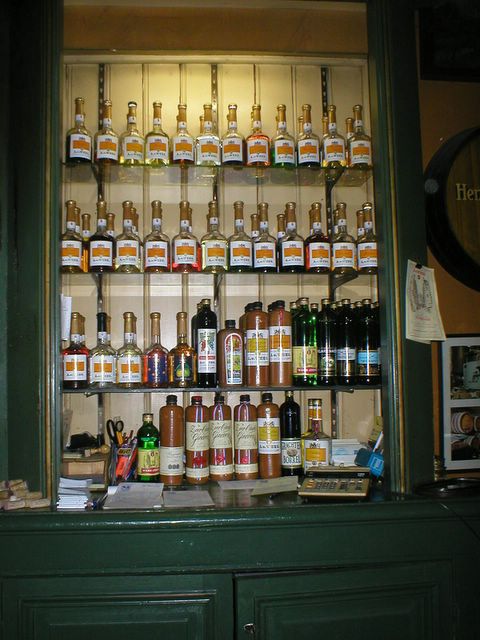
Display at De Admiraal ( Amsterdam) A few of the Genevers (aka Dutch Gin) they make Posted by Hello

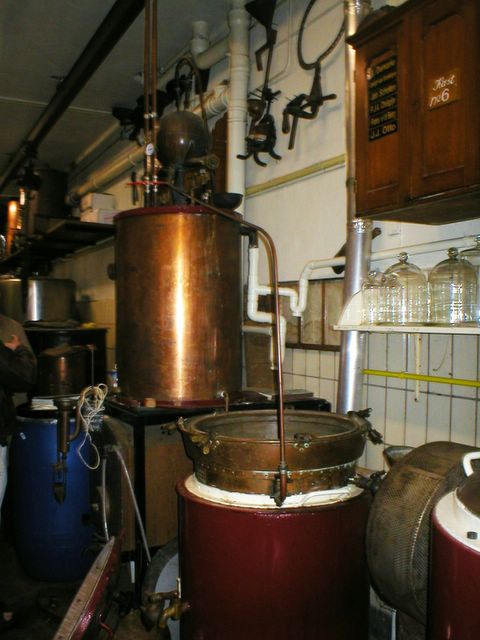
One of the Stills at van Wees (Amsterdam) Posted by Hello

A Small Sample of Van Wees Products at their Proefkalen De Admiraal on Herrengracht (Amsterdam) Posted by Hello

Wine Tasting in Roman Cave, France Posted by Hello

Cellar aging Room Van Wees, Amsterdam Posted by Hello

Me at Van wees Distillery, Amsterdam Posted by Hello

Wednesday, June 15, 2005

Mondovino The Movie

We went to see "Mondovino" a couple of days ago and I have to say it is a must see movie about wine and globalization of wine or maybe more to the point the world hegemony of wine driven by Robert Parker.
As I have stated before, I am not a fan of his or Wine Spectator (who is also featured in the movie).
While I like some of the wine he likes, I like a lot more wine that he does not like and I respect and honor the differences between different wines and terroir.
unfortunately the wine world (or at least the buying public) have increasingly been showing traits that are normally attributed to Lemmings rather than higher mammals.
Alarming numbers of the producers and buying public are flocking a singular type or model of wine, that singular type being a anointed Robert Parker wine ( a wine given a high score by Robert Parker).
Most of these wines have been micro managed, doped up, and blended beyond all recognition as to their original type and origin to fit a model of wine championed by Mr Parker. In many instance (in my opinion) these wines are manipulated in such a way as to mimic long aging in a short period of time and t remove terrior or any local variation. I refer to it as the McDonald's model of winemaking, fast, global, insidious, and lacking a soul. In any case back to the movie...
It is a wonderful compare and contrast between traditional winemakers and people like Mondavi, Parker, and Rolland.
It chronicles the struggles (and occasional victories) of the traditional winemakers and terroir, against the global homogenization of wine as represented by the above.

Thursday, June 09, 2005

Cognac is Brandy, But Brandy is not Cognac

In another installment of the Zen Riddles of Booze. Cognac is a brandy but not necessarily the reverse. Brandy come from the term gebrandtwien or burned wine ( Dutch/German origin).
In the middle ages wine began to be distilled in order to evade customs duties ( based on volume and further to reduce shipping volume and make it less likely to spoil in transit. When it arrived at its final destination it was watered back down to more or less its original strength. Many people found however that they liked distilled down. Brandy is an umbrella or generic term for a distilled spirit made from a fruit (as opposed to a grain). Here are some rough definitions:
Cognac is a form of grape brandy, produced under strict guidelines from certain varieties of grapes.
Armagnac is produced in a different area of France, and is quite different from Cognac.
Marc (French) is a form of unaged brandy similar to Grappa ( Italian) or Pisco (South America) all of which can run the range from lighter fluid to sublime depending on the distiller.
Aquadiente is the Portuguese version of grape brandy which may or may not be aged.
Calvados is apple an brandy produced in Northern France.

Sunday, May 01, 2005

Breakfast Of Champions - Scorpion Laced Mescal

I'm back after a couple weeks enforced sabbatical due to some highly unpleasant dental surgery.
In order to catch up I started in with 4 bottles of Scorpion laced mescal this morning. What the hell I thought, might as well get that one over with. Plus I promised the company I would try it before May 5th. No promises on what I thought about it of course, but it would be done and written up.
I have to say I had my doubts looking at it.
But I have to say it was a very pleasant surprise. Damn fine stuff. Still not crazy about the scorpions but very well made, eye opening stuff (no pun intended).

Thursday, April 28, 2005

Is it Grappa, Marc,Baguciera,or Vodka ?

A recent controversy has been what is vodka. Or, what are the allowable ingredients for vodka.
Pressure from more or less traditional vodka countries within the EU to make a ruling that everything except grapes (see above for some of the names of those clear alcohol spirits) could be used to make vodka. Spirit made from grapes had to be called something else - usually a name with zero recognition beyond the country of origin and even within those countries the names had generally negative connotations. This was obviously a attempt at protectionism. This rule was recently shot down after a fight by the Gin and Vodka Association in England.

Thursday, April 14, 2005

Tequila is a mescal but mescal is not a Tequila

Mezcal is a distilled product of the agave plant family. There are over 30 varieties of agave that can be used. Tequila uses a specific one, the weber blue agave. It also comes from a specific area in Mexico. Mezcal can be made from several different species of agave and is usually made in the Oaxaca area of Mexico. Tequila is a form of mezcal that is rather specialized and is distingushed from other mezcals for the most part because of the unsavory reputation mezcal had for years.
A basic analogy is the differences between cognac and armagnac. Mezcal is the country cousin, much less well known, earthier and in it's case much more traditional in its preparation than tequila ( which again is a form of mezcal).
The 'worm' by the way is actually a butterfly larvae (read catapillar) and is not present in Tequila.
Also a new trend is to replace the 'worm' with a scorpion. Look for my upcoming reviews or mescals at spiritsreview.com

Wednesday, April 13, 2005

Single Malt, Single Barrel, Single Single,Straight,Vatted Malts and Blends

Here are some other terms that can confuse and confound aspiring Whisk(e)y connoisseurs .

Single Malt: Usually applies to Scottish Whisky ( note lack of "e" ) or to whiskies ( again note Scottish spelling) that are trying to emulate the style. It means that the whisky comes from a single distillery and is not blended with whisky form another distillery but is probably the blending of a multiple barrel "dump" as it is called in the industry to create a distillery signature and consistent style.

Straight Whiskey: Whiskey that is made in a single distillery. The term or definition used in the United States ( for the most part) to describe what a Scot would call a single malt in terms of production ( not in taste !)

Single Barrel: This term is most commonly used in the United States to describe a bourbon whiskey (note the "e") that is from one distillery and bottled from one single barrel . Bourbon Whiskeys (again note spelling) are all single malts using the above definition although their composition and aging requirements set them apart in different ways. A single barrel bourbon is a further refinement in individual character as again the whiskey comes from a single barrel and is not blended with other barrels. That being said the barrels chosen usually represent a distillery style or signature that while consistent will vary within a certain range to keep peoples interest. Barrels to far outside the style are not selected as single barrels and will be used to blend "Straight" bourbon whiskey from the distillery or sold on the open market.

Single Single or Singleton: The Scottish version of a single barrel, see above. These are rarely done by the distilleries themselves and are usually encountered as merchant or independent bottling. You have to read the labels carefully as a merchant or independent bottling can be either a single malt or single single. If it is a single single it is usually referred to as a single cask bottling or singleton.

Vatted Malt: A blend of single malt whiskies only. No grain alcohol (rectified spirit) or other spirits can be added. It is a type of blend but is specific as to the type of ingredients. Just blended malt is a rather more slippery category as to allowed ingredients or components. That being said there are good blends out there. I am merely trying to distinguish the ingredients and definitions not the quality .

Blended Whisk(e)y: This is the most slippery term of the bunch. It usually means it is a blend of whiskey, grain alcohol and can include gods only know what else. Colorants, flavor enhancers, sweeteners, etc., There are some good blends out there that are outstanding examples of the blenders art but usually it means bottom shelf whisky that is cobbled together from various ingredients of doubtful origin.

Zen Riddles of Booze

Tequila is a mescal but mescal is not a Tequila, Cognac is a Brandy but a Brandy is not necessarily a Cognac, Bourbon is a Whiskey but not a Whisky, Scotch is a Whisky but not a Whiskey.
If you understand all this you do not need to read the next installment. If you don't, pour yourself a drink and read the next installment. Everything may not become clear but the headache will hurt less.

Friday, April 08, 2005


Paul Pacult, Jim Crile of The Glenlivet and Colin Scott of Chivas Brothers Picture By Mischa mack of the Thomas CollectivePosted by Hello

Press Release from The Double Scotch Party

FOR IMMEDIATE RELEASE CONTACT: The Thomas Collective

Alex Lange (alange@ttc-pr.com)

212/229-2294

PERNOD RICARD USA ANNOUNCES THE PUBLICATION OF
“
A DOUBLE SCOTCH”

New Book by Noted Spirits Writer F. Paul Pacult Chronicles Two Top Scotch Brands

WHITE PLAINS, NY – Pernod Ricard USA, importers of Chivas Regal and The Glenlivet, is pleased to announce the publication of “A Double Scotch: How Chivas Regal and The Glenlivet Became Global Icons,” a new book by noted author and spirits writer F. Paul Pacult (Wiley, April 2005, $24.95, Cloth). “A Double Scotch,” which chronicles the two brands that made Scotland's national drink a global phenomenon, was recently launched at a book signing at Keens Steakhouse in New York, where Jim Cryle, The Glenlivet’s Master Distiller, and Colin Scott, the Master Blender of Chivas Regal, joined Pacult to do a tasting of the range.

“We’re pleased to have such a notable writer as Paul Pacult to tell the story of The Glenlivet and Chivas Regal,” said Kevin Fennessey, Senior Vice President of Marketing at Pernod Ricard USA. “Paul’s reputation as one of the premiere spirits writers in the industry is the perfect match for communicating the legacy of these two top Scotch brands and his knack for engaging storytelling make this a unique must-read for any Scotch enthusiast.”

“A Double Scotch” tells the intertwined success stories of Chivas Regal and The Glenlivet—two Scotch whisky brands recognized the world over for their unparalleled quality. Seen through the prism of two families, it is an insightful, storied history of how two Scottish grocers from Aberdeen named Chivas, and one pistol-packing Highlands distiller named Smith, changed Scottish history over the span of two centuries. Overcoming severe taxation, illicit distilling, smuggling and world wars, they went on to

(more)

produce benchmark whiskies that became standards of quality the world over. Staged within the mysterious, breathtaking landscape of Scotland, “A Double Scotch” provides a window into how these enterprising people inextricably linked their spirit to its national heritage.

The book also includes an enlightening question-and-answer section with The Glenlivet’s Jim Cryle and Chivas Brother’s Colin Scott. Through this intimate exchange, Scotch enthusiasts will discover what makes these two brands superlative, as well as how these masters are able to maintain consistency over time. Today, Chivas Regal, at three million cases sold annually, is the world's most famous prestige blended Scotch. The Glenlivet, recognized as the quintessential single malt Scotch, is the #1 selling single malt in the United States.

About the Author

F. PAUL PACULT is the founding editor and publisher of F. Paul Pacult’s Spirit Journal – The Quarterly Independent Guide to Distilled Spirits, Beers, and Wines newsletter now in its 15th year of publication. He is the author of the critically acclaimed book American Still Life: The Jim Beam Story and the Making of the World’s # 1 Bourbon (Wiley, 2003). He is the wine and spirits columnist for Sky – the Delta Air Lines magazine, a contributing editor and the spirits tasting director for Wine Enthusiast Magazine, a contributor to CARGO, a special projects editor for The New York Times Magazine and the judging director at the annual San Francisco World Spirits Competition. He is also honored to be the only journalist worldwide to be a member of The Bourbon Hall of Fame, a member of the Armagnac Company of Musketeers as well as a life member of The Keepers of the Quaich Scotch Whisky Society.

About Pernod Ricard USA

Pernod Ricard USA is an American producer and distributor of fine spirits and wines. The company produces Wild Turkey Bourbon and Seagram’s Extra Dry Gin and in addition to Chivas Regal Scotch Whisky and The Glenlivet Single Malt Scotch Whisky, they import Jameson and Bushmills Irish Whiskeys, Martell Cognac, Jacob’s Creek and Wyndham Estate Wines.

New Series of Mildly Education Value

I'm going to start a mini series of pieces on various aspects of names and nomenclature of spirits that will cover proper names and designations, definitions and spellings interspersed with whatever else comes to mind in between. Please keep checking back. Also if you are reading www.spiritsreview.com be sure to hit the refresh button every so often ( like every week or so) otherwise your browser will serve up the old version and you will miss new reviews.

Tuesday, March 29, 2005

Alternative Use for a Cocktail Shaker or Cocktail Shaker as Funeral Urn

A while back a friend of mine who was a bartender died suddenly. He was cremated and wanted 1/2 of his ashes spread on his land and the other half put in a mausoleum.
We used a antique pepperpot type cocktail shaker (the metal kind with a cap on it and a strainer built in) that we bought for $9 to spread the first half of him around , then put the other half of him in the shaker and walled it up.
It was a fitting container for him and a lot cheaper than some cheezy urn.